What I Learned About Painting Clouds From Artist Isaac Levitan
 Isaac Levitan and the Art of Painting Clouds
What makes clouds so hard to paint?
Here's the honest truth: most artists — especially acrylic painters — avoid painting clouds. And I get it. The variations are so subtle. The edges are so soft. The colors shift almost imperceptibly from one zone to the next. In oils, you can blend for hours. In acrylics, the clock is ticking.
But here's what I've come to believe: if we can figure out how to paint clouds beautifully in acrylics, it opens up a whole new world of painting. Big skyscapes. Blustery afternoons. Quiet, luminous moments where the sky is more interesting than anything on the ground. All of that becomes available to us.
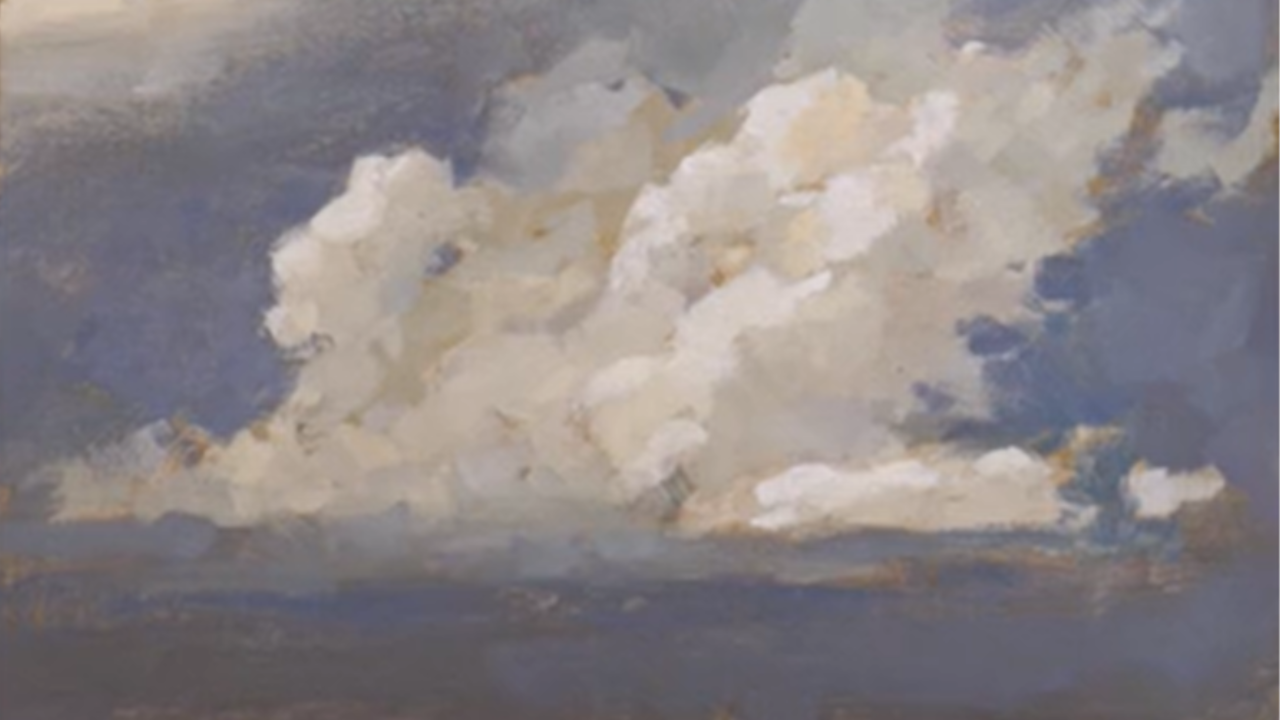
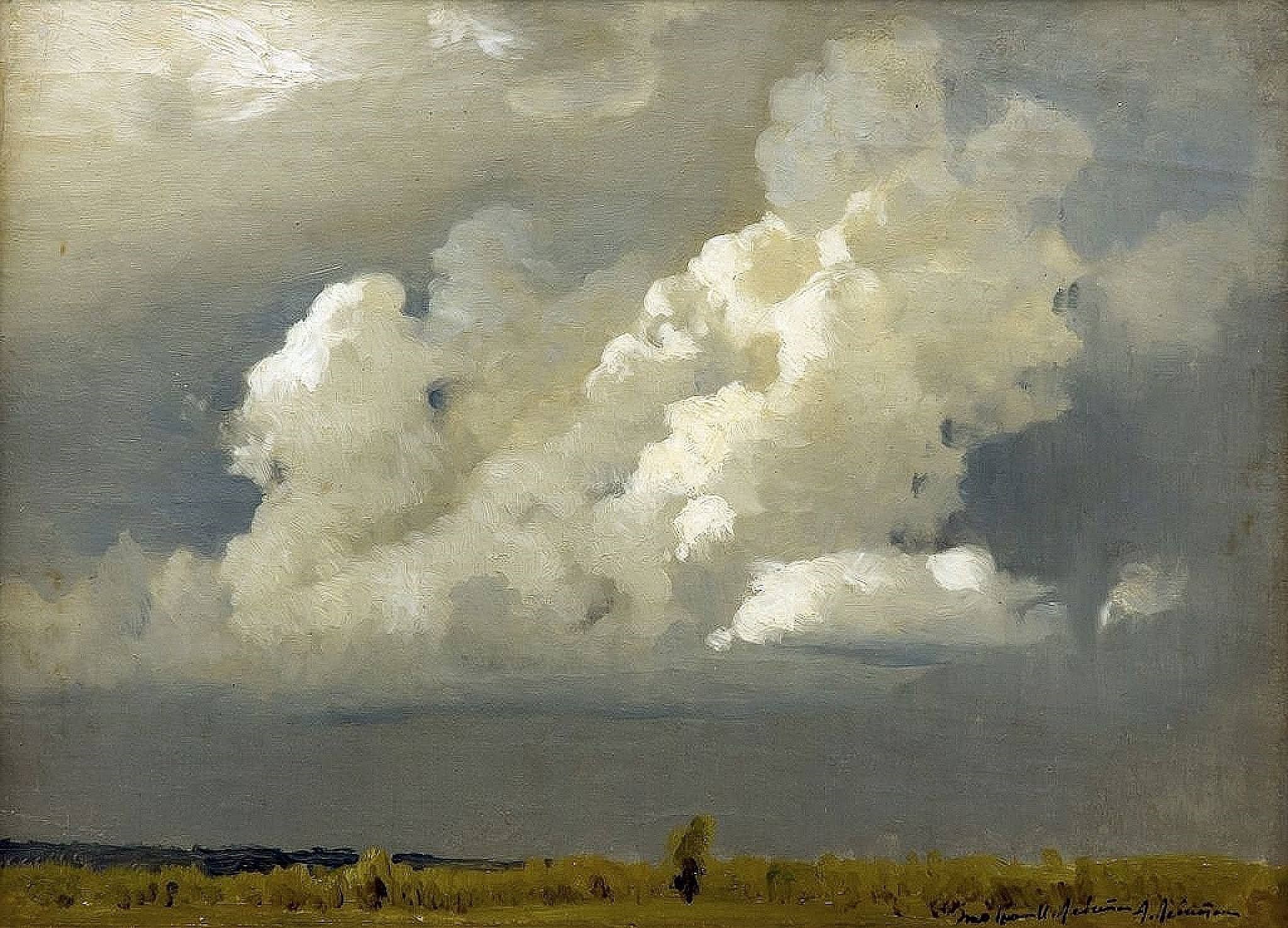
And Levitan's painting — simple, direct, almost entirely sky — is the perfect teacher.
What drew me to this particular painting is how much he stripped away. There's a minimal strip of land at the bottom. One lone tree. A faint line of shadow. And then almost the entire canvas is given over to this one grand, billowing cloud on a blustery day. He trusted the sky to carry the whole painting. And it does.
What I Learned
1. Clouds have four zones — and you need to mix them in advance. This was the biggest unlock for me in studying this painting. Before putting a single brushstroke down, I mixed four separate piles of color on my palette: the dark (the shadow areas underneath and deep within the cloud), the halftone (the transitional zone between shadow and light — there's a lot of this in a cloud), the highlight (where the sun is hitting directly), and a reflected light color (warm light bouncing back up from below, almost like it's reflecting off the tops of other clouds). Having these ready meant I could move quickly, confidently, and keep the transitions feeling smooth.
2. Values matter more than color. This surprised me a little. Within a cloud, the exact colors can vary — a little warmer here, a touch more blue there — and that variation actually adds beautiful nuance. But the values have to stay in relationship with each other. The colors need to live within a tight value circle. The moment the values fall apart, the cloud stops reading as a cloud. So I kept asking myself: is this lighter than that? Does this transition make sense? That discipline kept everything believable.
3. Clouds never have hard edges — ever. Anywhere the cloud meets the sky, or where the highlight transitions into the halftone, the edge needs to feel soft and airy. I was constantly feathering my brush strokes, smudging with my finger, looking for ways to dissolve rather than define. The moment you paint a hard edge on a cloud, something feels wrong — even if the viewer can't name it. Soft edges are the language of clouds.
4. Tie the landscape to the sky. At a certain point in the painting, the green strip of land at the bottom wasn't talking to the sky at all. It was sitting there like it belonged to a different painting. The fix was simple: carry a little of the gray-blue from the sky down into the bottom of the canvas. Just a few marks. Just enough to create the sense that the sky and the land are living in the same light, breathing the same air. It's a small thing that makes a big difference.
5. When you're stuck, let it dry and keep going. This is advice Levitan himself probably would have shrugged at, since he was working in oils on location. But for us, as acrylic painters, it's a gift. If you put something down and it's not right, let it dry. Come back. Acrylics give you a second chance — and a third, and a fourth. Don't fight the paint. Work with it.
These things working together — the pre-mixed value piles, the soft edges, the tied-together palette — create the feeling that you've painted something alive. Something moving. Something real.
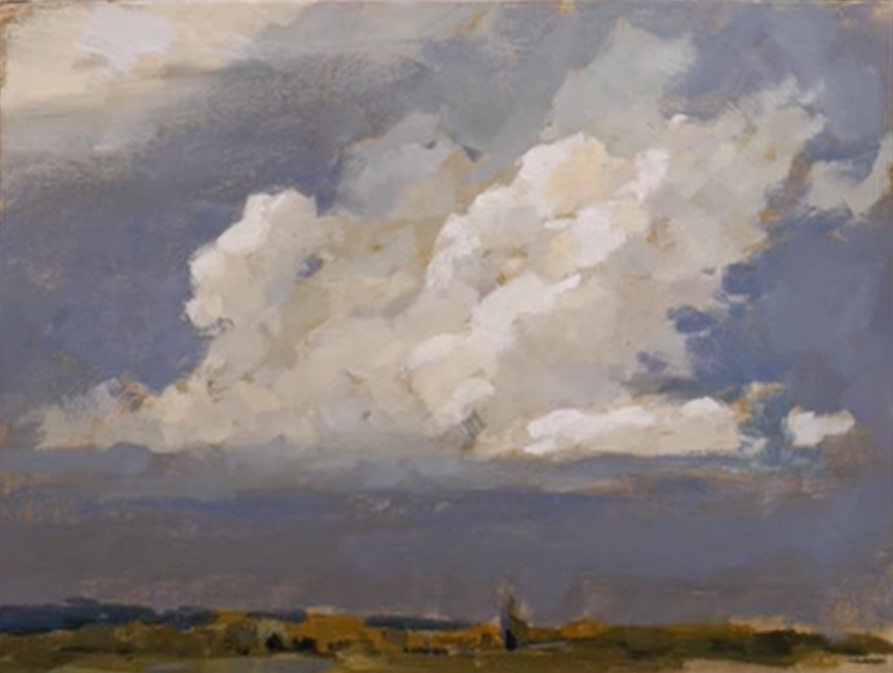
My demonstrated copy of Isaac Levitan's "Before the Storm"
More about Isaac Levitan:
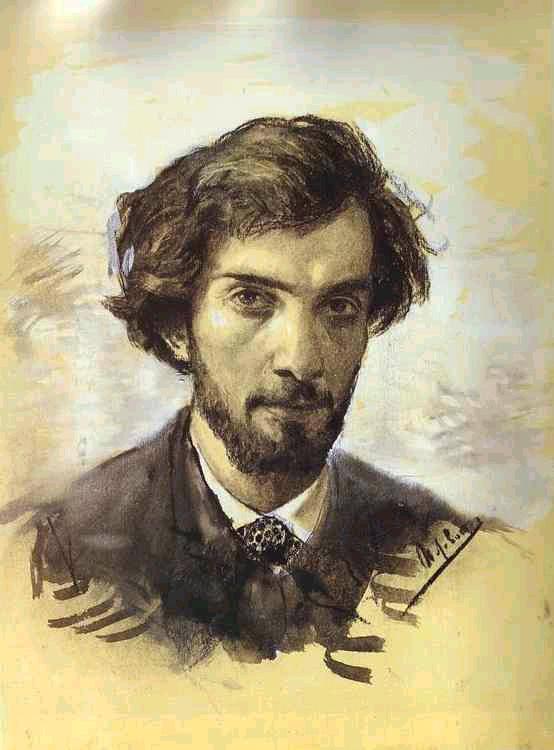
Isaac Levitan was a Russian landscape painter born in 1860 who became one of the greatest masters of mood in the history of art. He was a student and friend of Anton Chekhov, and the two men shared a deep sensitivity to the quiet emotional weight of the natural world. Levitan painted mostly Russian landscapes — rivers, fields, forests, skies — and his work is often described as lyrical, even melancholy. He had a way of finding the soul in an ordinary scene.
What I admire most, now having studied his work up close, is that Levitan painted from life. He was standing outside, looking up at a sky like the one in this painting, and capturing it with brushes and paint — no photograph, no pause button. Just his eyes, his memory, and decades of observation. When I think about how subtle the variations in that cloud are, and then I realize he was doing that entirely from direct observation... it's humbling. These artists were incredibly gifted, and I don't think we appreciate it enough.
Levitan died in 1900 at just 39 years old, leaving behind a body of work that continues to shape how painters think about landscape and light. Finding his work while looking for something else entirely felt like one of those happy accidents that painting sometimes gives you. I'm grateful it did.
You can access our full module on clouds by becoming an Acrylic University member! Click here for more info> https://www.acrylicuniversity.com/